Field of Science

Pages

Goat Moms Recognize Their Kids Saying "Ma!"


The mother goat's floppy ears perk up. From across the field, she hears one of her kids—not the new baby that's still nursing, but the grown-up kid who's packed up and moved to a different pen. Even though she no longer sees or feeds her older offspring, she'd know that bleat anywhere.

It's hard to know how well animals recognize and remember each other's voices; you have to follow groups of animals around for long stretches and keep track of how recently they've seen each other. Yet we have a few answers already. An Australian sea lion remembers its mother's voice for years after it's left her side. Cotton-top tamarins recognize relatives' calls even when they haven't seen them for several years. African elephants have been shown to remember a former group member's voice 12 years later.

  
Domestic goats are good subjects for this area of research: they're chatty, they're easy to find from one year to the next (since they live in pens), and they form close relationships between mother and kid. So researchers in the UK, led by Elodie Briefer at Queen Mary University of London, went to a Nottinghamshire farm to study vocal recognition among a small group of goat mothers.


The scientists recorded baby goats' bleating when they were five weeks old. Then they played back those recordings to the mothers while the kids were away from them. The mother goats' reactions—how much they bleated, how quickly they looked toward the source of the sound—were measured as a baseline.


More than a year later, the researchers brought their speakers back to the farm. By now, the goat kids they'd recorded had been weaned from their mothers for at least seven months. Mother and kid were living in separate pens where they couldn't see or hear each other. Meanwhile, another year's batch of babies had been born, and the mothers were busy nursing their new kids.


The scientists played the old recordings of their kids to the mother goats. But this time they were mixed in with recordings from other, unrelated goat kids that currently shared their pen. Would the moms be able to pick out the voices of their now-adult children from the other familiar bleating?


The mother goats didn't disappoint. They reacted more strongly to the sounds of their own offspring than to the sounds of the neighborhood kids. Acoustic analysis of the recordings showed that the moms weren't just mistaking the voices of their older kids for the similar sound of their younger kids. The goats had distinct voices, and their moms recognized them even when after they'd grown up and moved out.


If the mothers still reacted strongly to the recordings made when their kids were five weeks old, the authors reason, they've probably stored memories of their kids' voices throughout childhood. They may be able to recognize their offspring for many years afterward. (It would be nice to see the experiment repeated with new recordings of the adult offspring, though, so we'd be sure that the moms can still recognize their grown kids once they have more mature voices.)


Assuming mother goats can recognize their kids throughout life, there are some advantages. Goats are social animals, for one thing, so keeping track of each other is important. And there's a less cute reason to remember which animals are your offspring: Inbreeding avoidance, which is biologists' way of saying "not mating with your relatives." Kids sure do grow up fast.


Briefer EF, Padilla de la Torre M, & McElligott AG (2012). Mother goats do not forget their kids' calls. Proceedings. Biological sciences / The Royal Society PMID: 22719031

Images: goat kid Keven Law; Australian sea lion Berichard; cotton-top tamarin Ltshears; African elephant nickandmel2006 (all from Wikimedia Commons).

The Shambulance: Ionic Foot Detox Baths

(The Shambulance is a brand-new, occasional series in which I try to convince you not to spend your money on bogus health products. My Shambulance copilot is Steven Swoap, a biology professor and physiology expert at Williams College.)


Regular water is so lazy. You put your feet in a warm tub and sure, it's relaxing. Maybe afterward you scrape some dead skin off your heels and put on lotion and feel a little more presentable in sandals. But don't you wish that water was doing some real work? Why isn't it, say, sucking poisons out of your whole body through the soles of your feet while curing your every ache, pain, and allergy?

If this is how you feel, you're in luck: Certain spas will happily take 50 or 75 of your dollars in exchange for half an hour of "foot detox." This warm water tub is no ordinary foot bath, but one that contains "positive and negative ions from a special generator" (an electrical current, in layman's terms).

What exactly does that current do? One Chicago spa claims that "your body will undergo a life-changing cleanse, releasing...toxins, oils, acids, fats, heavy metals, cellular debris, and waste that have accumulated over your lifetime." Removing all that bad stuff (which your body, for some reason, stubbornly clings to unless aided by electric foot baths) leads to a host of benefits. Possible health effects name-dropped by foot detox purveyors include pain relief, improvement of eczema and psoriasis, better organ functioning, increased energy, and greater muscle strength. And—because why not?—weight loss.

Just in case any skeptics are tempted to scoff, the foot bath people have proof their product is working. "It is an amazing process to watch," another Chicago spa declares, "as the presense of these cleansed toxins and waste are deposited back into the water around your feet in a murky display of residue."

Want the benefits of frequent detoxifying foot baths without having to pay for spa trips? You can buy your own machine (comes with carrying case!).

Before you pull out the MasterCard, though, you might reconsider a few points. For starters, the idea that harmful molecules can exit your body through the feet.

"We definitely have organs to rid ourselves of compounds that are not useful. You can call them toxins, but that word is so often used incorrectly that I try to avoid it," says physiologist Steven Swoap. "Those organs are the liver and kidney."

Our livers filter unwanted materials out of our blood and chemically modify them. Our kidneys send those materials into the toilet bowl. The soles of the feet are, if you can believe it, not part of the equation. "I imagine that in some alternate universe, organisms evolved an excretory organ on the bottom of their feet," Swoap says. "But not in our world."

In response to a long list of health claims from one spa's website, Swoap says, "If I report that I got sick from reading this, would that be a good scientific study?" He calls the wide-ranging promises "simply ridiculous." Increased energy? Cells get their energy from molecules such as adenosine triphosphate (ATP), not from some sort of internal housecleaning. More muscle strength? "It is not clear to me how running a small electric current in a bath can improve muscle strength," Swoap says. "Wouldn’t body builders just lie around in the stuff?"

The murky water doesn't prove much, either. "The residue is most certainly corrosion of the electrodes once you put in some salt water and a little current," Swoap says. "This is just like a corroded battery—all nasty and brown." Instead of removing metals from their bodies, users are soaking their feet in a bath of iron, nickel, or other metal from the machine's electrodes. ("Yum," Swoap says.) He points out that someone could easily demonstrate this by running the machine without any feet in it and producing the same residue.

You may remember foot gunk being used to sell another product: Kinoki foot pads, which popped up in the As-Seen-on-TV aisles a few years ago. Their makers claimed that wearing the adhesive pads on the bottoms of your feet overnight would draw out toxins from your body and, again, cure all your ills. The proof, they said, was in the gross brown material found on the pads in the morning. But a 2008 investigation aired on NPR revealed that used Kinoki pads were chemically identical to unused ones; the pads simply turned brown in the presence of moisture. In 2010, the Kinoki manufacturers were banned from marketing their foot pads after the FTC charged them with false advertising.

Any company that's selling cleansing and curing foot products may similarly be living on borrowed time. Instead of looking for miraculously hard-working water baths, why not take a moment to appreciate all the hard work your body is doing on its own? You might even thank it with a nice soak in a regular tub.

Image: healthandmed.com

Thanks to Steven Swoap for helping me kick off the Shambulance road trip. Have a suggestion for a column? Write to me or leave a comment! 

Why We (Accidentally) Name Babies for Hurricanes


In the year after Hurricane Katrina made a toilet bowl out of New Orleans, baby names starting with "K" went up by nine percent. Why would new parents want to commemorate the costliest natural disaster in American history? It wasn't their fault, researchers say: The sounds we hear most often stick with us, and we end up bestowing them on our children.

Jonah Berger, a professor of marketing at the University of Pennsylvania's Wharton School, led a study of baby name popularity that will be published in the journal Psychological Science. The researchers looked at the frequency of all first names between 1882 and 2006, a dataset that included more than seven thousand names and 280 million babies.

Each of those seven thousand names was broken into sound chunks called phonemes. For example, "Karen" became five phonemes: K, eh, r, ah, and n. The researchers then asked whether a name's popularity in any given year could be predicted by the popularity of its component phonemes in the previous year. In a year with a glut of Karens, were there extra K's, eh's, r's, and so on popping up in non-Karen names the year before?

Berger and his team found that names were more popular when the phonemes inside them had been more popular the year before. (They didn't count the name itself; Karens from 1999, for example, were removed from the analysis of Karens in 2000.) And the first phoneme—the sound that starts each name—had the most powerful effect. When considered individually, phonemes from the middle or end of a name weren't nearly as influential.

The sounds of the names people hear often, then, seem to sway them when naming their own children. But there are giant tangles of cultural factors determining what names and sounds people have recently heard. To look for a cleaner example of the phoneme effect, the researchers turned to hurricane names.

Hurricanes are named using a rotating alphabetical list that was created in the 1950s. (The list runs A through W, excluding Q and U, which is why you'll sadly never see a Hurricane Xerxes or Quentin. Names that land on especially destructive hurricanes are retired from the list afterward, like MVP jersey numbers.)

The researchers guessed that after a very bad hurricane, when people were inundated with news reports mentioning Andrew or Bob or Irene, there would be an increase in babies with similar names. And since hurricane names are predetermined, the effect would be separate from any already-existing cultural influences (princesses, actors, tennis players).

After collecting data on every hurricane between 1950 and 2009, Berger and his colleagues looked at how baby names that shared phonemes with a hurricane changed in the following year. They found that damaging hurricanes were followed by a clear uptick in similar names.

Names are more likely to be trendy, Berger writes, when names with similar sounds have recently been popular. The effect might not be limited to names; other research has hinted that we favorite-playing humans prefer towns and occupations that share our initials. It seems we just can't help growing fond of familiar sounds.

If you want to see how popular your own name has been over the decades, what this year's top ten boy and girl names are, or how name popularity varies by state, you can do so at the Social Security Administration's baby names site. You'll also find all of Irene and Andrew's relatives at the Weather Underground hurricane archive. You may discover that your parents were just following the trends—or the tropical storms.


Jonah Berger, Eric Bradlow, Alex Braunstein, & Yao Zhang (2012). From Karen to Katie: Using Baby Names to Understand Cultural Evolution Psychological Science


Image: Tommy Lew/Flickr

This post was chosen as an Editor's Selection for ResearchBlogging.org

Overeating Makes Flies Obese, Diabetic, Dead


Fruit flies that eat human diets suffer human consequences, according to new fly-fattening research. Overeating caused diabetic symptoms in flies, whether they ate too much sugar or went Atkins. Though these obese fruit flies die even more quickly than usual, their short-and-sweet lives might help researchers learn about diabetes in humans.

Drosophila are pretty distant relatives to us—as should be obvious from their wings and external skeletons—but our bodies make and manage insulin in similar ways. Insulin is the hormone that regulates blood sugar; we humans manufacture it in our pancreases. Obesity and bad diet can fry our systems, making us resistant to our own insulin (like we become tolerant of caffeine or alcohol or other drugs, feeling less effect with greater use). This immunity to insulin is the hallmark of type 2 diabetes.

Humans with type 2 diabetes have to constantly monitor their blood sugar and may eventually suffer blindness, amputations, kidney damage, and early death. In search of a new tool for studying diabetes in humans, researchers at Southern Methodist University set out to create diabetic fruit flies.

Flies were raised on food that was overly rich in either sugar or protein (the only two ingredients they need to survive). "The flies live in their food," senior researcher Johannes Bauer explained in an email, "so each 'bite' they take contains more nutrients than those of flies living in [normal] food."

Adult flies that ate too much sugar gained weight dramatically, just like humans who overdose on sweets and sodas. The flies had grown about 30% heavier after just 10 days. Flies that were moderately overfed on protein also gained weight. But when they ate the highest amounts of protein, their weight began to drop again.

Bauer says the protein-guzzling flies didn't look as much like diabetics as the sugar eaters. Instead, they looked like carb-avoiding humans who enter a metabolic state called ketosis. "Carbohydrates are the major fuel source of the body," he says, "and when this is in short supply, the body will break down fat for energy. This effect is thought to be the cause for the initial weight loss seen, for example, on the Atkins diet."

Even though the Atkins flies were keeping trim, they weren't healthy. Previous research showed that overfed flies die early, whether they're eating protein or sugar. And ketosis isn't a normal state for flies' bodies or for ours, despite its appeal to dieters. The scientists described the high-protein flies as sluggish and frail.

The most exciting result (for the researchers, if not the flies) was that both overfed Drosophila groups developed insulin resistance. Like diabetic humans, their bodies stopped responding to insulin. It happened whether they ate too many calories from sugar or from protein.

This means researchers might be able to study how diabetes develops—and how to treat it—in fruit flies, one of their favorite model organisms. Fruit flies are unfussy and take up hardly any space; they make baby flies at an amazing rate; and we know their genomes inside and out.

Naturally there are limitations to studying a complicated human illness in a one-milligram insect. "The underlying principles are similar, if not identical," Bauer says. "But the more complex an organism is, the more complex the individual steps become."

Fruit flies could help researchers deepen their understanding of diabetes or develop new drugs to treat it. Those findings, though, might not always translate directly into humans. Even when our diseases look similar to flies', the big, intricate bodies that house us are our own problem.


Morris, S., Coogan, C., Chamseddin, K., Fernandez-Kim, S., Kolli, S., Keller, J., & Bauer, J. (2012). Development of diet-induced insulin resistance in adult Drosophila melanogaster Biochimica et Biophysica Acta (BBA) - Molecular Basis of Disease, 1822 (8), 1230-1237 DOI: 10.1016/j.bbadis.2012.04.012


Image: Mo Kaiwen 莫楷文/Flickr

Jumping Vampire Spiders Choose Victims by Headwear


It's reasonable for a hungry predator to hesitate when its prey appears to be two halves of an animal glued together and hopping up and down. Jumping vampire spiders faced with this decision took it slowly. But they eventually chose the tastiest-looking mosquito, ideally one stuffed full of fresh human blood. In the process, they demonstrated a complex decision-making system.

New Zealand biologist Ximena Nelson led the investigation of how Evarcha culicivora spiders choose which prey to attack. The East African jumping spiders are very particular eaters, dining solely on mosquitos that have recently filled up on blood. (Since only female mosquitos drink blood, this means male mosquitos are mostly off the menu.)

A blood meal doesn't just satisfy a rumbly abdomen; it also makes the spiders more attractive to the opposite sex. So it's worth a spider's effort to make sure that it's hunting the right prey. Stalking and killing what it thinks is a jelly-filled, only to discover it's really a glazed, is disappointing.

Earlier research had shown that vampire spiders can find their prey by sight alone; they don't need the smell of a blood-engorged insect abdomen to direct them. Nelson wondered what visual cues help E. culicivora home in on its prey. The spiders have great vision and eyes pointing in all directions. But will they simply attack any mosquito with a belly full of blood, or do they use other signals to find female mosquitos? If only part of a mosquito is visible, what hints will give them enough confidence to pounce?

To find out, Nelson's team tempted vampire spiders with various mosquito "lures." They used dead mosquitos rather than living ones, since they're less prone to flying away in terror when a spider comes after them. Dead mosquitos are also more amenable to being cut up and Frankensteined together with each other, which is exactly what the researchers did.

The scientists used three kinds of mosquitos: males, females fed only on sugar water, and females recently fed on mammal blood. After being dispatched, each insect was cut in half. Then the front and back halves were shuffled and recombined. This created female heads with male abdomens, male heads with blood-filled or regular female abdomens, and control insects that were normal (aside from the seam across the middle).

Those female mosquitos fed on mammal blood, by the way, had eaten well. I asked Ximena Nelson if the researchers fed their mosquitos using their own arms, an unsettling practice I'd heard of. "Yes, unfortunately that is the case," she said. "Not a pleasant experience for the victim."

After the monstrous mosquito lures were "mounted in a lifelike posture," the vampire spider subjects went through a series of tests. In some cases, the researchers made the lures jerk up and down to seem a little more lively. Sometimes one end of the lure was hidden behind a wall, so that only the mosquito's head or only its abdomen was visible.

Whenever females with blood-engorged abdomens were on the menu, the spiders went for them. But when given the choice between a normal-looking female mosquito and one with a male head, the spiders preferred their meals with the correct heads on them. And when the mosquitos' back ends were hidden behind a wall, spiders went after the ones with female front ends.

A test using virtual mosquitos on a screen (which the frustrated spiders jumped at to no avail) confirmed how the spiders were choosing their victims: In addition to looking for blood-stuffed stomachs, they also preferred female antennae.

Male mosquitos have plush, feathery antennae, while females' are simple and unadorned, like car antennas. In the photo below, a male is on the left and a female is on the right (with her head pointing toward the bottom corner).


Although E. culicivora spiders do choose victims for their blood-filled bellies, they use antenna shape as an extra clue to make sure they're choosing well. Plain female antennae tell a spider that its intended victim isn't just a male mosquito that overdid it on the sugar water.

It seems to be "a combination of cues from the head and from the abdomen that truly 'flicks the switch,'" Nelson says. Vampire spiders are slow, deliberate hunters that look closely before they leap. Once they take their pick, that well-fed female mosquito may be left regretting her own lunch choice.


Nelson, X., & Jackson, R. (2012). The discerning predator: decision rules underlying prey classification by a mosquito-eating jumping spider Journal of Experimental Biology, 215 (13), 2255-2261 DOI: 10.1242/jeb.069609

Images by Robert Jackson.

Why You Can't Kill a Mosquito with a Raindrop


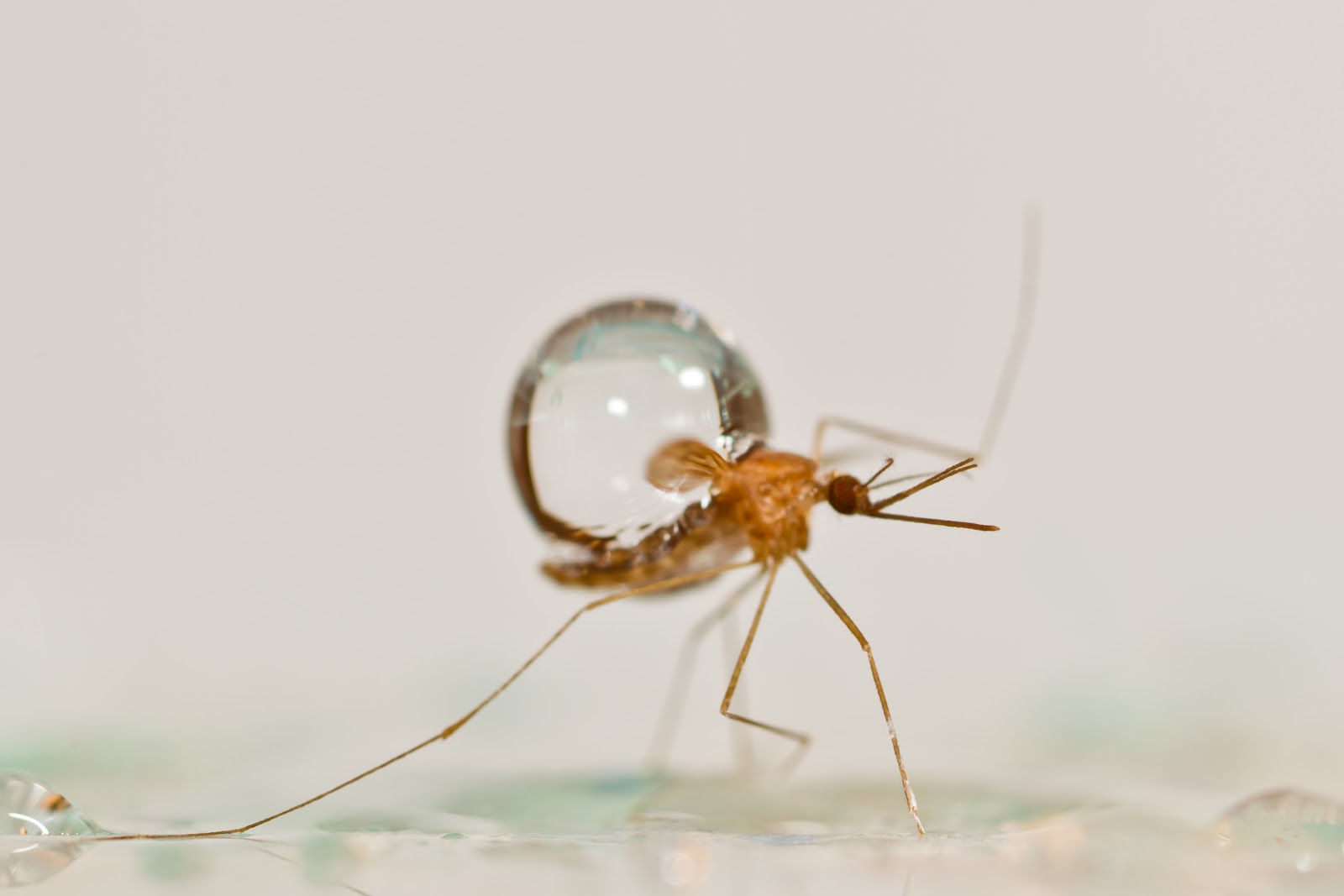
Compared to a spindly mosquito, the mass of a raindrop is like a bus bearing down on a human. Yet the delicate insects thrive in wet, rainy climates. To find out how mosquitos live through rain showers, researchers pelted them with water drops while filming them at high speed. They saw that the insects' light weight, rather than being a liability, might be the key to their survival.

David Hu is a professor in both the biology and mechanical engineering departments at Georgia Tech. He's previously studied how water striders take advantage of fluid dynamics to skate across the surfaces of ponds. Andrew Dickerson, a graduate student in Hu's lab, has used high-speed video to find out how dogs and other animals shake water off of themselves. And in their newest study of animals getting wet, the team asks why a rain shower doesn't flatten every mosquito around.

The researchers trapped mosquitos in small mesh cages and sprayed them point-blank from above with jets of water. This Supersoaker-esque blast was similar to raindrops falling from the sky at terminal velocity. To get detailed video of collisions, they also hit mosquitos with drops falling at a slower speed.

The first thing they saw was that mosquitos made no effort to avoid the water. And they seemed to know what they were doing, because all the insects that got hit survived.

Going to the tape, the scientists saw that the consequence of getting hit by a raindrop depends on what part of the mosquito's body takes the blow. Since the insects are so lanky, 75% of hits happen on the legs or wings. This can throw a mosquito into a brief tumble or even a barrel roll, but it recovers without much trouble.

Direct hits to mosquitos' bodies are a different kind of carnival ride. The speeding raindrops glom onto the insects and propel them downward. Mosquitos captured on camera sometimes fell as far as 20 body lengths while being pushed by a raindrop. For a human, that would be a 12-story drop and a quick ending to the story. But mosquitos are able to pull away sideways from the raindrops and continue on their way, unharmed.

The only danger seems to come if mosquitos are flying close to the ground when they're hit, leaving themselves too little time to escape. The authors note that one unlucky bug was driven into a puddle and "ultimately perished."

To crunch some numbers—and find out why no mosquitos were being crunched—the researchers turned to substitute bugs that were simply Styrofoam balls of different sizes and weights. Although a raindrop isn't any bigger than a mosquito, the insect is extremely lightweight compared to the water. When the heavy drop hits the airy mosquito, it's almost like hitting nothing at all. And this, the researchers found, is what keeps the mosquitos alive. By offering barely any resistance, a mosquito minimize the force of the collision. The raindrop doesn't even splatter when it hits.


Of course, a bus hitting a human is pretty damaging no matter how little resistance the person put up. Mosquitos have the added advantage of a hard exoskeleton to help them resist the blow.

There's another reason this impact is survivable, David Hu explained in an email: Even though the force of the collision is 100 times the mosquito's mass, it's still only equal to the weight of a single feather. ("If we were in a comparable situation," he added, "we would not survive.")

If the impact didn't kill us, the acceleration would. Humans being hurled downward generally black out around 2 or 3 G's. But a mosquito suddenly driven toward the ground by a raindrop experiences an acceleration of 100 to 300 G's. The authors note that "insects struck by rain may achieve the highest survivable accelerations in the animal kingdom."

Although not especially useful to people trying to kill mosquitos or survive vertical bus collisions, the research could prove very handy to engineers designing insect-sized robotic aircraft. To fly successfully through rainstorms, these aircraft might adopt some of the mosquitos' technologies. A low mass would minimize the force of collisions. And sprawled legs, the authors write, could give tiny aircraft enough torque to pull away sideways from a falling drop. Mosquitos also have water-repellent hairs that may help them separate from stuck-on raindrops; aircraft could achieve the same thing with hydrophobic coatings.

Now if they would only design the miniature robot planes to attack the mosquitos, we'd have some real excitement.


Andrew K. Dickerson, Peter G. Shankles, Nihar M. Madhavan, & David L. Hu (2012). Mosquitoes survive raindrop collisions by virtue of their low mass PNAS : 10.1073/pnas.1205446109


Images courtesy of the laboratory of David L. Hu.

Rare Blooms


John pauses with his cursor over a photo of a dark yellow flower. He seems to be debating whether to say something. "I call this one the penis orchid," he admits.

I see it. The Coryanthes bears a bulbous, upright projection, behind which is a bucket-shaped area filled with fluid. Male euglossine bees tumble into the bucket while trying to collect the orchid's fragrance, which they use like a cologne to make themselves more attractive to females. As a male bee repeatedly falls into and crawls back out of these buckets, he unwittingly pollinates the flowers.

It's a great story, but the flower's endowment might be distracting to the middle- and high-schoolers who read the magazine I edit. "Yeah," I tell him, "my photo editor will never let that fly."

I'm visiting my friend John Osterhagen to research an article for kids about orchids. John works for an insurance company by day, but returns home to an apartment bursting with orchid plants. There are eighty or so, living in his bedroom on rows of shelves and windowsills, under special lamps or misting devices. John's cat, Keiko, likes to chew the leaves of just one plant, so he keeps it tucked in his farthest corner.

Flowers aren't John's only self-admittedly strange hobby. He loves early music, origami, and coloring with Crayolas. But none of his other hobbies lives and breathes in his home with him. "People say in the orchid world that you 'get the bug,'" he says. A few fussy but handsome potted plants become shelves full of exotic hybrids and a membership to the Orchid Society. "It's as if the orchids themselves are manipulating you."

John also has the bug for orchid taxonomy, which is always changing as genetic studies revise the family trees guessed at by past centuries' naturalists. He rattles off genus names: Paphiopedilum, Phragmipedium, Bulbophyllum. Sometimes a genus becomes empty and abandoned as taxonomists shift all its species into different groups. John keeps up on the research and edits Wikipedia pages where he can.


The magazine story I'm working on is about deception. Orchids thrive on lying. Some grow petals that look precisely like the back of a female bee or beetle or wasp; a male of the targeted species will try his hardest to mate with the unresponsive flower part while the orchid quietly glues its pollen onto his head. Other species trap their pollinators in well-like petals that can only be exited through a tunnel rigged with pollen. There are orchids that mimic other flowers to attract the pollinators that drink their nectar. (Most orchids don't make nectar, the usual lure for insects, at all.) Those that seek to attract carrion flies mimic rotting meat, emitting a stink from masses of gut-colored petals decorated with maggoty white streaks.

John shows me examples on his computer and on his shelves while Keiko paces around our ankles. A petite epiphytic orchid—a species that lives on trees with its roots dangling into the air—has bloomed just in time for me to see it. He points into the innards of another flower, where I can barely make out the trap door flanked with pollen blobs.

And he points out several species that bear a speckled pattern around their centers, as if a breeze has generously dusted them with their own pollen. In reality, the pollen is waiting elsewhere in a large mass to be attached to a pollinator. John has a strong suspicion that the speckles are another kind of deception, meant to attract insects that eat pollen. "I don't know whether it's been studied academically," he says.


The flowers bloom infrequently and on their own schedules, most often around December or January. Even after putting so much effort into dressing up for a pollinator, they seem not to care whether they get pollinated at all. John says he sometimes gets up in the morning to find that an orchid has tossed a new, perfectly formed blossom to the ground overnight.

The whole family of Orchidaceae, in fact, can appear bent on self-destruction. They grow slowly, sometimes taking years to reach maturity. They're "insanely specialized to their pollinators," many wagering all their future generations on a visit from a single species. If pollinated, they produce seeds that are nearly microscopic. And those seeds can't sprout unless they happen to cross paths with a fungus that will enter into a symbiotic relationship and provide the nutrients the orchid needs. "It seems like the odds are stacked against them," John says.

Yet orchids are some of the most successful plants in the world. There are around 25,000 species, living on every continent except Antarctica and in nearly every kind of climate. They're either the largest or second-largest flowering plant family that exists, depending who does the counting.

The secret to their world dominance may be genetic. During the orchid's evolution, master genes that control the organization of the flower were duplicated. This gave the plant a huge amount of freedom to mutate. New flower shapes emerged to fill thousands, then tens of thousands, of ecological niches.

John doesn't breed his plants. With their expected pollinators never showing up, and John declining to pollinate them by hand, he says they're "the world's most sexually frustrated orchids."

But he does see plenty of mutants. The orchid tendency to create genetic monsters manifests even in his apartment. John shows me a plant that grows flowers with four parts instead of six, and another that has piles of unnecessary petals, "like a Frankenstein flower." He has a plant that can't keep its flowers' lips (the modified petals at the front and center) straight from its other petals. After the mottled fuchsia flowers open, the lips try to turn into petals while the petals start to curl like lips. In a photo, another flower grows an extra petal straight from its center, like an arm coming out of its face.

Orchid growers keep track of individual plants with an elaborate naming system that traces each plant's family history. Thanks to the finickiness of orchid growth, many of these species can't be cloned like other plants can. So their incarnations on John's shelves are one of a kind.

Whether they grow flawless blossoms or freaks, "that particular plant is unique in the whole world," he says. "Like a human."


All images by John Osterhagen. Top to bottom: An orchidarium; Paphiopedilum venustum (a Himalayan species species with a pattern that, John notes, looks like a brain); Jumellea comorense (native to the Comoros Islands in the Indian Ocean); and Dendrobium Negro (a hybrid of Southeast Asian Denbrobium species).