Field of Science

Pages

Showing posts with label birds. Show all posts

To Crash Others' Nests, Cuckoos Impersonate Birds of Prey


In the avian world, cuckoos are the villains you root for. These diabolical birds can trick others into raising the cuckoos' young instead of their own. From a thick playbook of deceptions, one trick cuckoos use is to impersonate local bullies. This apparently convinces their victims to let cuckoos walk right into their nests.

Cuckoos live all over the world, and most species are model citizens, building their own nests and raising their own offspring. But many species are so-called brood parasites, which sneak their eggs into other birds' nests. Some species match the egg's color to their host's eggs to disguise it, while others don't bother, depending how clever their preferred targets are. In certain species, male cuckoos goad the host parents into chasing them off while females creep into the nest and lay their eggs.

The parasitic cuckoo hatches earlier than the other eggs in its nest and gets a head start in begging the host parent for food. It may mimic the appearance of its nestmates. Often, it kicks them out of the nest altogether. The clueless host parent feeds and raises the young cuckoo until it can fly off on its own.

Obviously, it's in the best interest of host birds to keep cuckoos out of their nests in the first place. Parasitic cuckoos and their host species engage in a constant evolutionary arms race, with the parasite's tricks and the host's defenses always improving. Thanh-Lan Gluckman, a Ph.D. student at the University of Cambridge, and her advisor, Nicholas Mundy, studied one of these tricks: plumage that disguises cuckoos as birds of prey.

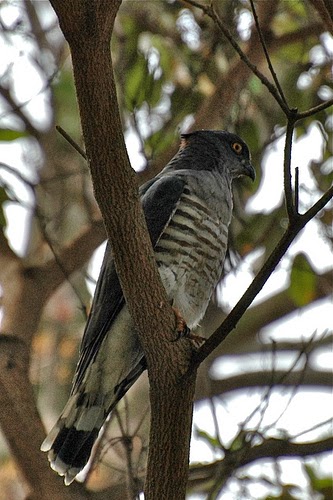
It's no secret that certain cuckoos resemble certain raptors, and vice versa. The hawk in the photo above (left) is named the African cuckoo-hawk because of the likeness. Gluckman and Mundy wanted to measure that likeness: How similar is the plumage of raptors and cuckoos? And is that similarity stronger in species that live in the same area, suggesting the cuckoos have evolved to mimic specific birds?

The researchers focused on the chest feathers, where many cuckoo species have a "barred" pattern that's similar to many raptors'. It makes sense that the cuckoo's front side would be disguised, rather than its back, because that's what a host bird sees as a cuckoo swoops toward its nest. (And the last thing it sees before its young are replaced with aliens.)

Using museum samples, the authors photographed the plumage of representative birds. Then they transformed the images digitally to represent how they'd look through a bird's eyes. Characteristics of the barred pattern—how big the markings are, how consistent or variable the pattern is, and so on—were compared between five Old World cuckoo species (each representing a different genus) and raptors that share their territory.

All five cuckoos had patterns that matched a local raptor, such as a hawk or buzzard that overlapped with their territory. But when the scientists compared pairs that didn't live in the same area, there was no match. This suggests that cuckoos don't just imitate raptors in general; instead, they've evolved to match specific birds that live around them.

If the raptor it's imitating is local, that means the cuckoo's intended victim—the bird whose nest it's about to invade—will recognize it too. Gluckman says the purpose might be frightening host birds so they don't attack, "or making them misjudge what the cuckoo is for long enough to access the nests." A cuckoo can toss its host's eggs from the nest and lay its own in just ten seconds, she says. Alternately, males that are imitating a dangerous raptor might convince host birds to chase after them, also buying the female time to sneak into the nest.

It will take more research to show exactly how host birds react to an approaching cuckoo disguised as a bird of prey. Probably how they should react is to just move underground, because nothing else seems to be working.


Images: Left, African cuckoo-hawk by Ken Clifton; right, Oriental cuckoo by Tom Tarrant (both via Flickr).

Thanh-Lan Gluckman, & Nicholas I. Mundy (2013). Cuckoos in raptors' clothing: barred plumage illuminates a fundamental principle of Batesian mimicry. Animal Behaviour DOI: 10.1016/j.anbehav.2013.09.020

Coloring In Birds' Bellies with Magic Marker Makes Them Healthier


Remember when you were a kid and the magic marker boxes always had some sort of really elaborate drawing on the back? As if to say, "Buy these eight wide-tip Mr. Sketches and you, too, will be able to create a photorealistic portrait of a scarlet macaw"? But when you bought the markers and tried to copy the picture, it always came out as a stupid magic marker bird? You might have gotten more realistic results by coloring directly on a real animal. Some scientists tried this, and changed the birds' entire quality of life.

In North American barn swallows (Hirundo rustica erythrogaster), males and females with darker-tinted bellies are able to have more young. But they don't get their tan tummies by lying in a UV bed. The birds develop their color months before the breeding season starts, and it depends on both genetics and their health at the time.

Biologists call dark bellies on barn swallows an "ornament," like long tails or showy sets of antlers in other species. These traits may not serve a practical purpose, but they can advertise to potential mates how healthy or hardy the animal lugging that long tail around is.

Ecologist Maren Vitousek at the University of Colorado, Boulder, and her colleagues wanted to know whether barn swallows' ornamental belly feathers could also work in the other direction. A bird's health or fitness affects the color of the feathers—but can the color of the feathers also affect the bird's health?

The researchers captured 60 female barn swallows in Colorado, shortly before the time of year when the birds would be pairing off with mates. Using marker, they colored in the entire belly area of half the birds. The shade—PrismaColor light walnut no. 3507—was within the natural range of hues for barn swallows. Then the scientists sent the newly made-over birds back out into the world.

About a week later, the scientists began to recapture the birds. (They found 36 out of the original 60.) Ordinary, uncolored birds had higher levels of oxidative damage in their blood than when they were first captured. Their bodies had been under stress. But birds with darkened feathers actually had less oxidative damage than before.

Vitousek, who's now at Cornell University, thinks coloring in female birds' belly feathers made their lives easier. "Darker plumage may signal social status in barn swallows," as it does in some similar birds, she says. If so, other birds may have judged their tanned peers to be of higher status, and possibly more likely to win a fight. "As a result, they may be challenged less," she says.

Even though birds or other animals sometimes develop their showy traits well before the mating season, this kind of feedback loop would let these traits remain honest signals of how healthy an animal is. Fitter birds make darker feathers, and darker feathers seem to keep birds healthier by sparing them harassment. "What we are finding is that the appearance of an individual alone can also influence physiological state—and probably fitness—by changing social interactions," Vitousek says.

And all it takes to change a bird's social status is a quick pass with magic marker. Maybe it can be a post-retirement hobby for that Mr. Sketch package artist.


Maren N. Vitousek, Rosemary A. Stewart, & Rebecca J. Safran (2013). Female plumage colour influences seasonal oxidative damage and testosterone profiles in a songbird. Biology Letters DOI: 10.1098/rsbl.2013.0539

Image: by Walter Siegmund (via Wikimedia Commons)

This post has been submitted to the 2013 blog contest held by the National Evolutionary Synthesis Center (NESCent).

How Many Continents Does Katy Perry's "Roar" Video Take Place On Simultaneously?


The video for Katy Perry's newest single, "Roar," has been viewed almost 36 million times since it appeared online four days ago. In case none of those views were yours, a quick plot summary: A woman crash-lands in the jungle with an attractive but inconsiderate boyfriend in safari gear who's eaten by a tiger at 0:40. She's scared at first, but soon befriends a monkey, is bathed by a helpful elephant, and changes out of her old clothes into (spoiler alert!) a leopard bra. And sings.

On her road to empowerment, Katy gets help from a diverse array of animals. So diverse, in fact, that their being together in the jungle might be the most fantastical element of the video.

First there's the monkey, seen above inspiring Katy to turn her stiletto* into a spear. It's a capuchin, native to Central and South America.

What about the beast that disposed of the boyfriend? Katy sings "I've got the eye of the tiger," and she's got the whole body of it in her video. But tigers live only in Asia, so either the big cat or the monkey seems to have taken a wrong turn across an ocean somewhere.


Elephants can live in Asia as well, so maybe Katy's pachyderm friend (who does double duty as shower head and clothes hook) is in the right place. Asian elephants, though, have distinctively small ears that sit low on their heads. The fellows with the big flapping ears—on full display in the picture at the bottom of this page—are African elephants.


So now we're up to three landmasses at once. Perhaps this bird can settle the tie: it looks like a great hornbill, a tropical bird from Asia.


Then there's the creature whose teeth Katy is brushing in this scene. Its short and rounded snout, unlike a crocodile's long, pointed one, suggests it's an alligator. That's one more point for the Americas. (A crocodile's bottom teeth also protrude when its mouth is closed, while a gator's don't. But this prop only appears in the video with its mouth wide open. It may not have a hinge.) 


A crocodile would have given another point to Africa. Sorry, cradle of civilization! But wait—sneaking into the frame during the final seconds of the video is a baboon, a monkey that lives only in Africa (except for a desert-dwelling species in the southern tip of the Arabian Peninsula).


To break the three-way tie between continents, let's go back and take a closer look at the birds in the video. There are a couple of macaws, the striking parrots from Central and South America:


And key to the plot of the whole video is this red bird. Katy uses its feathers to build a lure that tempts the tiger, which she ultimately subdues in a roar-off and turns into her pet.


The red bird also provides a plot twist for our purposes. I sent the picture to ornithologist and Guardian blogger GrrlScientist for identification. "Oh wow," she wrote back, "a female eclectus parrot." The males are bright green with orange beaks, looking like a different species altogether. Eclectus parrots don't live alongside the capuchin, the elephant, or the tiger: they're native to northeastern Australia, New Guinea, and neighboring islands.

At least four parts of the world, then, are represented in Katy's jungle. (Don't worry about the leopard bra—our heroine fashioned it out of a scarf she was wearing on the plane.) It's a little surprising not to see a lion in the video, since it's the only animal aside from the tiger that actually appears in the song's lyrics. But then again, lions prefer the savanna to the forest. Maybe that would have been too unrealistic.


*I'm not sure of the species of shoe.


Images: screenshots from "Katy Perry - Roar."

Help Desk: Chastity Belts and Other FAQs


Hello!

I'm on vacation this week. With any luck, as you read this I will be lying in the shade with a book or having a hilarious misunderstanding with a non–English speaker. I will not be thinking about en-dashes, as I did just now. I will try not to think about beige liquid diets.

While I am away, please refer to these FAQs for any concerns you might have. They're not Frequently Asked Questions so much as Fairly Awkward Queries: search terms that, through some whim of a Google or Bing algorithm, brought people to this blog. I hope that their questions were answered eventually—or, at least, that they're enjoying their summers.


are cuckoo birds real
Yes, unlike the dragon dishwasher or manticore microwave, the cuckoo clock is an appliance based on a real animal. 

how to outsmart an 8 year old
Nineties Trivial Pursuit?

covered in bees 
If your hands are free to type, I have to think you're overstating the severity of the situation. At best you're sprinkled in bees.

a mutation of a lion and a monkey
I'm not sure about the lonkey, but you can see some other imaginary animal hybrids in this gallery at Wired. (I contributed the suggestion for the cuttlephant.)

chastity belt for 2 months

I'm sorry to hear about that.

been in a chastity belt for 9 months
Do you have any advice you'd share with a seven-months-earlier version of yourself?

chastity belt why on why now
I knew I'd regret this post.

fish adoption form
I've never tried this personally, but I'm pretty sure they just let you take them home from the store in a plastic bag.

orangutan tool use fish
Is the orangutan using the fish as a tool? Is the fish using the orangutan? Is this why you wanted to adopt it?

pretending to be paraplegic 
I'm going to stop you right there and say there HAS to be a better way to make your Match profile stand out.

i draw worms out of the ground
Maybe you could be a new X-Man? Like Storm, but Worm? Though in a different comic universe, if Robin is your sidekick, this could be distracting.

miniature poodle evolved
It was survival of the fittest in the Tundra of Purses, and once the miniature poodle had developed its portable stature and warm, hypoallergenic coat, it dominated its niche.

what do polar bears hate
Wild tundra poodles.

where baby point in female 
Um.

a real octopuses that tie you up
Ooh! This might be a good tactic to try on that 8-year-old.

unicorn horns photo 
I'm afraid I have some bad news.


Previously: Help Desk, Relationship Edition; 12 Days of Inkfish, Day 4: Help Desk


Image: Aryc Ogre (via Flickr)

Your Bird Feeder Could Be Bad for Birds


A free meal might seem like just the thing for your bird friends in winter, especially if that meal takes place in front of your picture window. But your feeder could be harming some bird species more than it's helping them. Even if it's a squirrel-proof seed tube or a pinecone rolled in peanut butter, there's still no such thing as a free lunch.

"We are really only in the early stages of understanding exactly what effects bird feeding is having on our wild bird populations," says Kate Plummer, an ecologist at the British Trust for Ornithology. Britons love to feed the birds. The BTO says that about half of everyone in the United Kingdom does it.

To find out how extra food during the winter months might affect wild birds, Plummer and her colleagues used populations of blue tits (Cyanistes caeruleus) that had never set eyes on a bird feeder. The birds lived at nine different sites in the woods. Researchers set up feeders to provide six bird groups with food (either straight fat, or fat plus vitamin E) while the other three got nothing. Over the course of three years, they rotated which bird populations were fed so they could better compare the results.

The scientists weren't interested in how extra food affected the birds eating it—they wanted to know what happened in the next generation. In nest boxes the following spring, they found that birds that had eaten at feeders hatched smaller chicks. Ultimately, fewer of these chicks grew up and left the nest.

Plummer says there are a few possible explanations. The fatty diet, for one, may have made birds nutritionally unbalanced by the time it came to egg-laying season. An earlier study that fed blue tits peanuts instead of straight fat found that it was beneficial to the next generation (though there were other differences between the studies too).

Feeders might also allow weaker birds to survive the winter, eventually hatching scrawnier chicks and bringing the whole population's average down. Or extra food in winter might encourage birds to invest resources in egg-laying, only to find come spring that their nests aren't in a great spot for food after all. The real answer may be a combination of factors, Plummer says.

Two other recent studies of woodland tits found that supplementing their food over the winter led to fewer chicks raised in the spring. But a similar study in woodpeckers found just the opposite. Bird feeders might be helpful for some species and harmful for others, possibly due to their different nutritional needs.

There may also be "winners and losers of bird feeding," Plummer says, that depend on the combination of species sharing a feeder. Dominant species might outcompete other birds, for example. Birds at feeders might also share diseases while they're pecking at the same seeds.

"People shouldn't stop bird feeding," Plummer says, at least not yet. It's too early to assume that feeding birds is always harmful. So go ahead and fatten up your feathered friends this winter. That is, as long as you can live with the possibility that the scene through your picture window isn't doing them any favors.


Image: David Lewis (via Flickr)

K. E. Plummer, S. Bearhop, D. I. Leech, D. E. Chamberlain, & J. D. Blount (2013). Winter food provisioning reduces future breeding performance in a wild bird Scientific Reports DOI: 10.1038/srep02002

Better IQ Testing for Animals: There's an App for That


It's 2013, and laboratory pigeons are demanding an upgrade. Well, maybe they aren't demanding so much as continuing to do whatever tasks get them their pigeon pellets. Nevertheless, switching from analog to digital testing could mean more rigorous studies, better statistics, and a chance for previously ignored animals to try their paws at cognition research.

One of the classic cognitive tests that psychologists like to give animals involves two or more strings. At the far end of one string, there's a treat. The animal has to figure out that tugging on the near end of this string will gradually bring the reward close enough to eat.

How classic is the string test? In a recent Animal Cognition paper, Edward Wasserman of the University of Iowa and his coauthors list 74 different papers involving this experiment. Animals subjected to string-pulling tasks have includes apes, monkeys, birds, cats, rats, and Asian elephants. The experiments have been limited, though, to animals that can grasp and pull on a string or rope. Another constraint is the time it takes an experimenter to physically set up the strings and refill the food dishes over and over again.

Wasserman and his colleagues used a pigeon focus group to try out a new kind of string test with no string at all. The whole thing took place on a touchscreen, which you can see above. When pigeons pecked at the square on the near end of a "string," the "dish" on the other end moved a little closer. One dish was an empty black box; the other was a photo of pigeon feed. When a pigeon reeled the food dish all the way in, a tasty (non-virtual) pellet dropped out of a dispenser.

The four pigeons in the study quickly got the gist of things, learning to peck the end of the string attached to the food. They started off with simple tasks, in which the strings were short and didn't cross over each other. Then the strings got longer, appeared at various angles, and eventually crossed. These tasks were increasingly challenging to the pigeons. But even for the hardest tasks, the first string they pecked was usually the correct one.

Unlike in a real string test, there was no pulling—no physical weight of food to focus on dragging closer. Still, Wasserman thinks the touchscreen experiment is an accurate substitute for the real thing. In videos like this one, you can see the pigeons bobbing their heads along the strings as they work, seeming to understand the logic of the puzzle. The authors compare the experiment to a game of Angry Birds, which also simulates real physics (albeit with slingshotted cartoon animals).

Also unlike a real string test, the researchers were able to instantly change the length or placement of the strings. They put their pigeons through tens of thousands of trials without much trouble. All of this means better statistical analyses and more reliable results are possible. Using a touchscreen "allows us to conduct experiments with much greater rigor than would otherwise be the case," Wasserman says.

The new method could also let researchers try this kind of testing on any animal that can work a touchscreen, Wasserman says—"even those without dextrous appendages." For example, fish. He also suggests mammals such as dogs, horses, or cows, as well as birds that can't use their claws like hands. One aquarium has already demonstrated that its penguins can play an iPad game. From the aquarium's video, though, it's unclear whether the penguin is truly enjoying the app for cats, or if trying to nab an onscreen mouse is turning it into an Angry Bird.


Wasserman, E., Nagasaka, Y., Castro, L., & Brzykcy, S. (2013). Pigeons learn virtual patterned-string problems in a computerized touch screen environment Animal Cognition DOI: 10.1007/s10071-013-0608-0

Image: Wasserman et al.

Tone-Deaf Birds Disrupt Society, Are Easier to Get into Bed


While male birds are singing elaborate arias and flashing their feathers, it's easy to imagine their female counterparts are unimportant actors. Duller and quieter, all a lady bird has to do is hold still and let one of these frantic performers mate with her. Yet in brown-headed cowbirds, at least, the quiet female keeps the whole society in order. Scientists discovered this by targeting a tiny portion of the female brain and frying it.

Males of the species Molothrus ater use their songs to compete with each other and to woo females. Once a a mating pair forms, they stay faithful to each other for the whole mating season, the male guarding his partner from rivals.

Near the top of the bird brain, a region called nucleus HVC controls females' choosiness toward their potential mates. Scientists at the University of Pennsylvania and Wilfrid Laurier University performed brain surgery on female cowbirds, carefully destroying only this region. Then they put their lobotomized females back into the dating arena to see what would happen.

First, the ladies listened to recordings of male songs. The researchers played tunes sung by a variety of males and observed the females' responses. (When they like what they hear, female cowbirds show it by crouching down in a copulation-ready pose.)

Normal females were choosy, only responding to the highest-quality male songs. Females who'd had brain surgery, though, responded positively to every song.

The researchers wanted to see what effect the females' new, lax attitude would have in cowbird society. So they put post-surgery females, normal females, and males in one big group together. Then they watched.

At first, it looked like nothing was different. Females missing their HVC seemed to act the same as females with intact brains; once they were all together in the aviary, there was no clear difference in how often females approached male birds or in how they "chattered" back at males to encourage their singing.

Nevertheless, something had changed. The other birds in the aviary treated post-surgery females differently. For one thing, females missing their HVC were serenaded by a greater variety of males, even once they'd chosen a mate. Normally, a female who's bonded with a male hears his song almost exclusively. This is a measure of how strong the bond between partners is, says study author David White. Now, with more males bending a female's ear, her pair bond was weaker.

There were other changes too. With the altered females introduced into the group, female birds competed more for mates. And the whole hierarchy of male birds, which is established before the breeding season starts, was disrupted. Male cowbirds sing at each other to show who's dominant. After the HVC-less females came to live with them, the rules about which males were dominant singers shifted significantly.

"The result in this paper turned everything around for us," White says.

Previously, it had seemed to be the male cowbird's responsibility to create a strong bond with his partner. Females appeared to be passive agents in the group. "They don't sing, they don't fight," White says. "They don't, to our eye, do much of anything." Yet when the choosiness was erased from females' brains, the whole group dynamic changed. "Now we could see that it was the female that was playing a much more active role in pair-bonding, and in all sorts of other roles within the social network," White says. Everything depended on her song preferences.

Incidentally, it's not clear why female cowbirds bond with males at all.

Females have likely evolved to pick mates whose songs demonstrate—somehow—that they have the best genes. Then the males keep singing to the females throughout the breeding season, strengthening the bond between them.

Usually, White says, bird couples only form strong bonds when both parents will need to care for the young. But cowbirds "are very bad parents overall" who abandon their eggs in the nests of other birds. The powerful bond between cowbird partners "really makes no sense," White says.

Yet once they're bonded, males direct almost all their singing to their partner and never try to mate with other birds. "They follow each other around, they eat together, he comes when she calls him," White says. If a female dies or disappears, he adds, "her pairmate just becomes a wreck. We call it the widowed male phenomenon."

After the loss of his mate, the male gives up for the season. "He flies around looking for her," White says. To him, at least, the quiet female never seemed unimportant.


Maguire, S., Schmidt, M., & White, D. (2013). Social Brains in Context: Lesions Targeted to the Song Control System in Female Cowbirds Affect Their Social Network PLoS ONE, 8 (5) DOI: 10.1371/journal.pone.0063239

Image: female brown-headed cowbird by JanetandPhil (via Flickr)

Homing Pigeons Never Stop Learning Ways to Get Home


A young homing pigeon must learn quickly how to find its way home from the strange neighborhoods where humans insist on leaving it. At first the bird does this by relying on its crudest instincts, returning to its roost along a route full of youthful zigzags. Over time, though, it refines its methods. A mature pigeon takes a much simpler route, because it has drawn itself a more complex map.

Homing pigeons have been subjected to all kinds of research. The latest study used GPS devices, which the birds carried in little Teflon backpacks. Ingo Schiffner of the Queensland Brain Institute and Roswitha Wiltschko of Goethe-Universität Frankfurt studied pigeons at three different ages: juveniles (6 to 7 months old), yearlings (the same pigeons in their second year of life, after going through a training program), and older trained birds (at least two years of age).

Wearing their tracking harnesses, the birds were released from various sites that ranged from 3.2 to 23.5 kilometers away from their home loft in Frankfurt, Germany. Here are the routes some of the birds took when returning to their home (the square) from a release site 6.8 kilometers away (the triangle):


You'll notice that some pigeons traveled by more, shall we say, scenic routes than others. The researchers calculated each bird's "efficiency" and found that the youngest group of pigeons were the least direct fliers. On average, they traveled more than three times the distance of a straight-line trip between the two points. (The pigeon researchers, in a bit of a mixed-species metapor, refer to this ideal trip as a "beeline.")

The two older groups of birds were much more efficient, flying no more than 25 percent farther than they needed to. Since their youthful zigzagging days, they had gone through a training program that had them practicing as far as 40 kilometers from their home roost. Now more familiar with the features of the landscape around their home, they could navigate it easily.

But that didn't mean the pigeons stopped refining their internal maps after their first year. Schiffner and Wiltschko also calculated something called the "correlational dimension," which is the number of factors that seem to be contributing to a system—in this case, pigeon navigation. 

Previous research has suggested that homing pigeons have multiple tools in their navigational toolkit. In various experiments, "pigeons have been deprived of visual cues, magnetic cues, olfactory cues, infrasound cues, and their gravitational sense," Schiffner says, "yet pigeons are still able to find their way home." Rather than relying on just one tool at a time, they seem to use several.

The correlation dimension is meant to count how many tools each pigeon uses to complete a trip. The youngest pigeons usually hovered close to 2. But year-old pigeons had a somewhat higher score, and the oldest pigeons were closer to 3. In his previous research, Schiffner says, pigeons have seemed to use as many as 4 types of navigational cues simultaneously. 

This suggests that pigeons keep refining their mental maps as they age, adding new elements—visual landmarks, say, or the smell of a local factory—to others such as sunlight and magnetic fields. "I cannot say yet which factors pigeons are using," Schiffner says, but he believes the factors add up with age. He and Wiltschko report their results in the Journal of Experimental Biology. Schiffner adds, "I assume that pigeons continue to learn and integrate new information into their navigational map as they grow older."

Attaching GPS devices to animals is currently trendy; there's a whole new journal dedicated to the subject. But humans have a long history of rigging our technologies to pigeons. At the start of the 20th century, German apothecary Julius Neubronner designed and patented a little camera on a harness for homing pigeons to carry (he had previously used the birds to ferry prescriptions and drugs for his patients).

The German military toyed with using Neubronner's pigeon-camera technology for reconnaissance during World War I. With the cameras hooked to timers, the birds could take pictures above enemy lines and carry them back home. These days we're attaching our instruments to the accommodating birds not for the sake of spying on our enemies, but to decode the secrets of the pigeons themselves.


Images: Homing pigeons by Amanda Dague (via Flickr); figure from Schiffner and Wiltschko; pigeon cameras by Julius Neubronner (via Wikimedia Commons).


Schiffner, I., & Wiltschko, R. (2013). Development of the navigational system in homing pigeons: increase in complexity of the navigational map Journal of Experimental Biology DOI: 10.1242/jeb.085662

Good Coot Parents Let Kids Starve, Make It Up to Them Later


Too many mouths to feed? Just make your babies fight each other to the death! That's a strategy some bird parents have been using since even before The Hunger Games was popular. It means the strongest chicks get stronger while the weakest ones conveniently stop showing up to the table.

One type of bird takes this family drama a step further: after letting the biggest chicks bully their siblings for a while, parents suddenly decide the runts are their favorites and begin beating up the older chicks themselves. Authors looking for the next dystopian mega-hit, take note.

"Many species of birds show 'hatching asynchrony,'" says Daizaburo Shizuka of the University of Nebraska, Lincoln. This means they stagger the hatching of the eggs within a nest. When some chicks emerge from their eggs days later than others, the younger birds are doomed to be outweighed and outcompeted by their older siblings. Blue-footed boobies, for example, produce two mismatched chicks; one may peck the other to death or shove it out of the nest. (If you think that's horrifying, you haven't heard about sand tiger sharks, which eat each other inside their mother's womb.)

The polite way to say "letting half your babies die" is "brood reduction." Why hatch a runty egg at all? Parents may allow more siblings to live if food is plentiful. Or a second egg might be a kind of insurance in case the first doesn't hatch.

American coots are waterbirds that lay large clutches of eggs and may space out their hatching over a week or more. This means some siblings end up much heftier than others. At first, young coots follow their parents around, relying on their parents to feed them insects and plant material they find by diving. Siblings don't physically attack each other, but older birds easily out-jostle smaller ones for food. Half of all chicks die of starvation.

Over several years, Shizuka and Bruce Lyon, an ecologist at the University of California, Santa Cruz, monitored 75 American coot families on a lake in British Columbia. They snuck every new chick away as it hatched to give it a color-coded tag. Spying on these families while their chicks ate or starved, the researchers discovered a highly unusual system at work.

During the first 10 days after hatching, younger coot chicks often died of starvation. But any runty chicks who survived this period saw their luck turn around. Parents suddenly started playing favorites. Each coot parent picked one preferred chick out of those who'd hatched last, and gave that chick the most food. Heightening the drama, moms and dads each chose a different favorite.

To discourage bigger siblings from asking for so much food, the parents spent more time "tousling" these birds. In humans this means "affectionately messing up someone's hair," but in birds it means "grabbing your baby by the head and shaking it." As you might imagine, it's pretty convincing. The beefy siblings backed off.

Once parents switched to spoiling the runts and beating up the bigger kids, late hatchers became just as likely to survive as their siblings. The youngest chicks even grew slightly larger than their older brothers and sisters.

This system may be a way "for parents to try to get the best of both worlds," Shizuka says. First, coot parents allow brood reduction to happen, watching their chicks compete to the death. Once the family reaches its optimal size, he says, "parents can take matters into their own hands to make sure that the youngest chicks that are still surviving end up getting enough."

Don't throw out your parenting books yet. Although this method seems to work for the coots, scientists still aren't sure why so many birds have evolved elaborate strategies that require siblings to murder each other—or why chicks go along with it. Shizuka says, "It's safe to say the matter is not resolved."


Shizuka, D., & Lyon, B. (2013). Family dynamics through time: brood reduction followed by parental compensation with aggression and favouritism Ecology Letters, 16 (3), 315-322 DOI: 10.1111/ele.12040

Image: Bruce E. Lyon

Need the Time? Ask a Rooster


"The connection with the sun coming up is a misconception," asserts an article in the rural lifestyle magazine Grit. "Roosters crow all the time." Some roosters in Japan would like to loudly disagree. They've shown scientists that their crowing has everything to do with what time of day it is—something they don't even need the sun to know.

Tsuyoshi Shimmura and Takashi Yoshimura, both of Nagoya University in Japan, investigated whether a rooster's crowing is tied to its circadian clock. That is, does the bird's internal sense of night and day determine when it's noisiest? Or do roosters crow at random hours—"morning, noon and night, not to mention afternoon, evening and the parts of the day that don’t have names," according to a disgruntled neighbor-to-roosters quoted in the Grit story?

Like any scientists studying how animals follow the sun's rhythms, the researchers began by shutting their subjects indoors. In a controlled environment, they kept the roosters on a strict schedule of 12 hours in the light and 12 hours in the dark.

Recordings showed that the roosters did not crow at random. A sudden burst of crowing came two hours before the artificial dawn, and the birds gave another "cock-a-doodle-doo" immediately after the lights came on. (Though in their country, the authors point out, it's "ko-ke-kok-koh.")

Then the scientists turned the lights out entirely, keeping the birds in a permanent night. The roosters at first continued to follow crowing cycles of roughly 24 hours, with only their internal clocks keeping them on schedule. Over the course of two lightless weeks, this rhythm gradually wound down.

In the barnyard, though roosters need their circadian alarm clocks for any pre-dawn crows, they can rely on other cues to trigger their crowing at sunrise—say, the sun. So Shimmura and Yoshimura next checked whether light itself causes crowing.

Starting with roosters that were living in permanent night, they tried exposing the birds to a little bit of light at the dawn hour. A few of the roosters crowed. When the researchers used brighter and brighter light, more and more of the birds crowed in response, as if recognizing the sun. A sound recording of other roosters crowing also worked to set their birds off.

Yet just flipping on the lights wasn't enough to make a benighted bird start crowing. When the light and sound signals came at "dawn," the roosters readily responded. When researchers used the same signals later in the "day," their birds didn't respond as strongly. And when they tried the signals at "night," the roosters didn't crow at all.

Even though they were living in permanent dark, roosters weren't fooled by seeing a fake sun at any old time. To get them crowing in earnest, the signals of sunrise had to come at the same time that the birds' bodily alarm clocks rang.

Roosters seem to be expert timekeepers. This knowledge, though, may not make come as much consolation to their neighbors.


Shimmura, T., & Yoshimura, T. (2013). Circadian clock determines the timing of rooster crowing Current Biology, 23 (6) DOI: 10.1016/j.cub.2013.02.015

Image: by -JvL- (Flickr)

Jays Know Which Worms Their Sweethearts Crave (Do You?)


Finding just the right gift for a significant other sometimes means relying on hints; this is especially true if you are a bird and your significant other is also a bird. Even the cleverest corvids aren't great with wish lists. Male Eurasian jays, though, seem to be able to deduce which treats their mates want most.

Sharing food is an important courtship ritual for the Eurasian jay (Garrulus glandarius). Passing snacks to each other helps the birds form, and nourish, long-term relationships. A female might accept any tidbit her partner gives her, whether she wants it or not, for the sake of boosting the bond—or just because she plans on stashing it for later. If a male can correctly guess what foods his mate prefers, though, he could increase his value in her beady eyes.

Figuring out what's in another animal's mind is no mean feat. Yet Eurasian jays are a member of the famously bright corvid family; relatives have been known to reenact Aesop's fables, outsmart small children, and sled down snow-covered roofs. Nicola Clayton and other researchers at the University of Cambridge looked for evidence that these birds are also capable of seeing from another's perspective.

The experiment relied on "specific satiety," which is when an animal gets tired of one kind of food but still has an appetite for a different food. This phenomenon is familiar to anyone who pushes away a plate of pasta, feeling stuffed, and then considers a dessert menu.

For the seven pairs of Eurasian jays in the study, the foods in question weren't pasta and tiramisu but worms and more worms. Specifically, wax moth larvae and mealworm larvae. When they were first fed on one kind of larva and then offered a choice between two bowls, both male and female birds preferred to eat the kind of larva they hadn't already had.

To see whether male jays understood that females felt this way too, the researchers fed female jays either wax moth or mealworm larvae while their male partners watched from the other side of a screen. Then they offered the male both kinds of larva, and let him choose which ones to pick up and pass to his mate through the screen.

After watching their mates eat one kind of larva, male jays were more likely to feed them the other kind, Clayton reports in PNAS. It wasn't because the males themselves were hungry for that kind of food; the researchers checked this in a separate experiment by offering the males their own bowls of larvae after watching females feed. Having already eaten meals of "soaked dog biscuits, cheese, seeds, nuts and fruit," the males had their own preferences about wax moths versus mealworms (two flavors you won't find in a Whitman's sampler). But when feeding their mate, they followed her preference instead.

Nor were the females telling their mates what they wanted, in some secret bird language, right there at the screen. The researchers know this because when males couldn't see the first feeding, they failed to give their mates their preferred larvae. The males had to see females being fed to guess what they'd want later.

The study used a small number of birds in unnatural circumstances. If Eurasian jays can truly put themselves in each other's shoes, though, they are members of the cognitive elite. Deducing another's intentions or desires is something we humans rarely admit other animals are capable of. But then, it can be hard to take a hint.


Ostojic, L., Shaw, R., Cheke, L., & Clayton, N. (2013). Evidence suggesting that desire-state attribution may govern food sharing in Eurasian jays Proceedings of the National Academy of Sciences DOI: 10.1073/pnas.1209926110

Image: Eurasian Jay mating pair engaged in food-sharing, by Ljerka Ostojic.

This Penguin: An Unexpected Journey


The humble king penguin chick had no way of knowing, when it woke up that day, that tall creatures from far away would come to send it on a journey. Nor could it know that its journey would become the subject of a manuscript read and studied by many. (It still doesn't know that part, because it's a bird.) 

When the humans came, the penguin was in its crèche, a cluster of young birds left behind while their parents foraged. Other penguins young and old stretched away from it in all directions. All at once, the chick was lifted from the ground by a pair of human hands. A cloth hood was pulled over its head. The researcher spun the bird around three times, then set off, carrying the bird away from the colony at a fast clip. 

Human and penguin traveled a circuitous route meant to further disorient the bird. When they reached their destination, the human spun the penguin three more times. Finally the chick found itself on solid ground, the hood pulled away from its eyes. Its colony was nowhere in sight.

The penguin was standing inside a circular arena about 10 meters across, surrounded by a meter-high wall of cloth. A scientist quickly fitted a pair of pads, like earmuffs, over the chick's head, deadening the sounds it heard. Then the penguin was left alone.

For fifteen minutes, following cues in its head that were inscrutable to the human observers, the penguin wandered inside the arena. Its instincts told it to return to the crèche right away, so its parents could find it when they came back. While it tried to discover the right direction, human eyes watched and recorded. Finally the walls of the arena came down; the bird was free to go.

It set off waddling across the frozen ground, still wearing its earmuffs. The bird was less than 200 meters from the colony but still couldn't see it. The ocean, though, was in sight. The chick walked straight to the shore. Then it hung a left and headed, correctly, for its colony. Finally it reached the crèche and the other chicks it had left behind. A piece of wood was on the ground, left by the human to mark the spot where the penguin had stood before its abduction.

This traveler was only one of many young penguins the humans lifted from their crèches in those days. Some, instead of earmuffs, had magnets temporarily attached to the backs of their heads. Some were made to travel by night. Some heard a recording of the colony broadcast loudly from speakers within the arena.

The researchers, who came from the University of Oxford and the CEFE in France, hoped to learn from the journeying birds the secrets of penguin navigation. Earlier visits to penguin crèches had told them that the young birds navigate partly by sight, but that most of them could still find their way in the dark—so some other talent was at work too.

Chicks with magnets on their heads did not fare any worse than usual. This revealed to the humans that the penguins didn't rely on sensing the earth's magnetic fields (as homing pigeons are able to do). 

The 18 earmuffed birds were also just as likely to navigate home as non-earmuffed birds. But out of the 16 who made it home without help, researchers noticed that 6 took an unusual path. Like our hero, they seemed to orient themselves by first walking to the ocean, then following it back. It was an intriguing hint that the earmuffs, which quieted the sound of the squawking penguin colony but didn't block it out entirely, were changing the birds' navigation strategy.

The second experiment involving sound truly befuddled the young birds. When speakers inside the arena played the sounds of the colony, almost all the penguins oriented themselves toward the speakers instead of toward home (in the opposite direction). Several chicks stood in front of the speakers, calling to them plaintively.

Five minutes after the walls came down, nearly all the undisturbed chicks were well on their way back to the colony. But many of the chicks who had heard the speaker noises lingered close to the arena. A few set off in the wrong direction entirely. 

The humans made sure all the young birds made it back to their crèches in the end. Afterward, lead author Anna Nesterova told the tale of the traveling penguins in the Journal of Experimental Biology.

From her story, Nesterova drew the moral that penguins use acoustic cues as part of their navigational toolkit. The sound of the distant colony seems to call them back. But the visual landmarks around the birds are also important, and there may be other clues they take in as well. 

As adults, king penguins must navigate between the colony (which may span several kilometers) and their foraging grounds. Upon returning to the colony, they find their partners and chicks by calling out and listening for the right voices among thousands—a task that would seem to require magic. Someday, we meddling humans may learn the secret of how these birds get there and back again.


Nesterova, A., Chiffard, J., Couchoux, C., & Bonadonna, F. (2013). The invisible cues that guide king penguin chicks home. The use of magnetic and acoustic cues during orientation and short-range navigation Journal of Experimental Biology DOI: 10.1242/jeb.075564

Images courtesy of Anna Nesterova.

12 Days of Inkfish, Day 5: Running on Water


Human courtship rituals—if you believe television commercials, anyway—are lame. The guy who kneels down right at the jewelry store counter ("It fits perfectly!" "Well honey, that's because I already had it sized") has nothing on birds who walk on water for each other.

Grebes are diving waterbirds that live in the Americas and Eurasia. To pair off, they follow an elaborate courtship choreography that includes trading bits of food and mimicking each other's motions. In the ritual's conclusion, both birds suddenly haul their ungainly bodies out of the water and run together on its surface. The grace of the birds and the physics of the maneuver both seem impossible.

You can see a pair of Clark's grebes do their courtship dance in this incredible video from the BBC. Jewelry companies, take note: there's no prelude to romance quite like swallowing a live fish.


Image: screen grab from BBC Life: Birds: Partners for Life

Malaria Makes Its Victims More Tempting to Mosquitos


Think mosquitos have a special fondness for you? Do they choose to target you over adjacent humans? No matter how badly you have it, things might be worse if you were infected with malaria. New research in birds shows that malaria parasites somehow make their victims more attractive to mosquitos. After all, the parasite needs a lift to its next destination—so it forces its sick host to flag down a ride.

Malaria, one of the top killers worldwide among infectious diseases, isn't caused by a virus or a bacterium. The culprit is a one-celled protozoan, called Plasmodium, that comes in a couple hundred disease-causing flavors. Plasmodium falciparum is the species that causes most malaria deaths in humans.

Various other Plasmodium species infect birds, reptiles, and mammals ranging from apes to anteaters. Whichever animal it prefers, the parasite needs to travel to new hosts via the belly of a mosquito. If possible, Plasmodium shouldn't just rely on chance—it should encourage mosquitos to bite its host.

In a 2005 study, researchers found hints that mosquitos are more attracted to the smell of a malarial child than a healthy one. (This was only true once the parasite had reached the right life-cycle stage for spreading to other people.) Giving malaria to kids is hard to justify ethically, though, even if you then treat them with antimalarials as those researchers did.

To pursue the question without leaving behind a trail of sick children, researchers in France turned to birds. Author Stéphane Cornet, of the Centre d'Ecologie Fonctionnelle et Evolutive, says the avian malaria parasite the team used infects more than 30 bird species around the world. For their experiments, they used canaries.

Mosquitos could prefer sick animals simply because they're easy targets. "Infection often renders hosts lethargic, as we are when we feel sick," Cornet says, "so that they are less able to defend themsleves against [mosquito] attacks." But he and his coauthors were more interested in whether malaria changes the particular bouquet of an animal to tempt to passing mosquitos. So they placed all their canaries inside PVC tubes with only their legs sticking out. This way, the birds' behavior and appearance wouldn't matter.

Fifty canaries were divided into pairs. Then the researchers released 70 hungry female mosquitos into a cage with each pair of birds (or, from the mosquitos' perspective, a cage holding four bird legs). After the mosquitos had feasted, the authors checked the DNA of the blood in their bellies to find out which bird each mosquito had chosen. Every mosquito choice test was repeated three times.

After testing mosquitos on healthy birds, the researchers infected one bird in each pair with avian malaria and repeated the tests 10-13 days later, when the birds were sickest. Two weeks after that, they tested the mosquitos and birds a final time. By then, 9 birds had died. But the surviving infected birds had entered the "chronic" stage of infection, when the parasite lies low and the victim isn't as sick.

Mosquitos weren't any more interested in acutely ill birds than in healthy birds, the researchers found. This might have been because the malaria had driven down their red blood cell counts, making their blood less delicious to mosquitos. But once the canaries entered the chronic stage of malaria, mosquitos clearly preferred to feed on the infected birds. The authors report their findings in Ecology Letters.

Cornet believes malarial birds give off some signal to attract mosquitos, such as extra carbon dioxide or a specific odor. What exactly that signal is, and how the Plasmodium parasite manipulates its host into sending the signal, remains a mystery.

A canary is of course not a person, and their malaria parasites are different from ours as well. But there are similarities in how the two parasites act on their hosts, Cornet says. Humans, like birds, might give off some mosquito-enticing perfume when infected with malaria. Finding this perfume could help prevent malaria transmission in the future. And even before that happens, Cornet says, it's useful for people who model the spread of malaria to know that mosquitos aren't choosing their victims randomly.

If you're still feeling resentful toward mosquitos, it may help to know that the malaria "perfume" is really a trap. Mosquitos that carry Plasmodium parasites are about a third less fertile than they would be otherwise, another study this year found. Drinking from infected hosts is bad for mosquitos just like it's bad for the next animal they bite. But, like us, they're helpless to Plasmodium's wiles.


Cornet, S., Nicot, A., Rivero, A., & Gandon, S. (2012). Malaria infection increases bird attractiveness to uninfected mosquitoes Ecology Letters DOI: 10.1111/ele.12041

Image: Travis S. (Flickr)

Math Shows Penguins Only Care about Themselves


Don't let the adorable mini-orchestra-conductor look fool you: penguins aren't that nice. When emperor penguins huddle together during Antarctic storms, they act like they're all in it together. But a new mathematical model shows just how the clusters of birds keep warm, accounting for everything from their geometry to the speed of the wind. Concern for one's fellow bird, it turns out, isn't a factor.

Regardless of your motivations, huddling together in a group is a great way to wait out a frigid storm. Instead of burning up their own energy reserves trying to warm their bodies, emperor penguins can rely on the warmth of a bunch of big feathery animals pressed together. There may be ten or hundreds of bodies in the huddle. Inside, the temperature is between 20 and 37.5 degrees Celsius (a cozy 68 to 99.5 degrees Fahrenheit). In the chilliest storms, penguins squeeze as tight as 10 birds every square meter.

Those huddles aren't motionless, though. With a continuous slow shuffling, the penguins rotate through the formation. Birds with their backs exposed to the wind creep away from it, up the sides of the huddle, until they find some protection. Meanwhile, birds that were formerly on the warm interior find themselves on the outside.

Three applied mathematicians at the University of California, Merced, set out to create a computer model of penguin huddling. Aaron Waters, François Blanchette, and Arnold Kim wanted to find out how well the birds' strategy works—and whether any penguins are left out in the cold.

To pack their penguin huddle as tightly as possible, the mathematicians imagined the birds on a grid of hexagons. This is the best way for circles to squeeze into a plane (think of a honeycomb), and scientists in the field have observed that real penguins arrange themselves roughly this way. The researchers also assumed that "penguins in this huddle have uniform size and shape."

Next, they added wind to the model, which flowed around the huddle differently depending on its overall shape. Then they calculated the rate at which each computerized penguin was losing body heat. They sent the coldest penguin shuffling around the outside of the huddle until it found the warmest spot it could stand in, then started over with the new coldest penguin.

The simulated penguins constantly shifted positions within the huddle, just as real penguins do. Over time, the model huddle tended to take on the shape of a flat-sided oval and travel slowly downwind (as penguins on the windward side continuously moved away from it).

When they calculated the flock's heat loss, the authors discovered that their model huddle was very fair: every penguin lost approximately the same amount of body heat. But these model penguins were only programmed to maximize their own warmth, not to consider the warmth of other penguins or the group as a whole. This means that even if penguins are only looking out for themselves, the whole huddle stays warm, as the authors report in PLOS ONE.

Just because emperor penguins can be totally selfish doesn't mean they are, the authors point out. It's still possible that penguins are altruists, organizing their huddle by thinking about the group as a whole. But it's not necessary to explain how they behave in the wild.

There's one flaw in the penguins' strategy: the elliptical shape a huddle tends to take on isn't optimal. A less stretched-out formation would help the whole group stay a little warmer. Maybe the emperor penguins should consult with a mathematician.

*********

ADDENDUM: Francois Blanchette, who was traveling when I first contacted him, says that this research was inspired by (what else?) March of the Penguins. While watching the movie, he noticed that factors in the penguins' environment, such as wind flow and heat transfer, were relevant to his own field of fluid dynamics. "I figured there should be a problem I could address that had to do with penguins," he says. "I was looking to do something different than my usual line of research."

With penguins out of the way, Blanchette and his coauthors are now interested in modeling other groups of living things, such as bacterial colonies. "However, not being biologists," he says, "we are not very familiar with other biological systems where such a model could be useful." If you're a biologist with a clump of organisms you'd like to model, let him know.


Image: Emperor penguins, by Mtpaley (Wikimedia Commons)

Waters, A., Blanchette, F., & Kim, A. (2012). Modeling Huddling Penguins PLoS ONE, 7 (11) DOI: 10.1371/journal.pone.0050277

P.S. If you enjoy reading about math and self-interested animals, you may like my earlier post Geometry Proves Sheep Are Selfish Jerks.