Field of Science

Pages

World's Ugliest Fish Jam Each Other's Mating Calls


Perhaps understandably, the male toadfish doesn't rely on his looks to attract females. He uses a bellowing, foghorn-like call to lure the ladies instead. But he'd better beware of his neighbors—nearby toadfish, a scientist has discovered, use short grunts to stealthily jam each other's signals.

In the spring, at the start of breeding season, male oyster toadfish nestle into rocks and debris on shallow seafloors in the western Atlantic. From his hidden nest, the male sends out his tuba blasts. A female who hears something she likes comes to the nest and glues down her eggs. Then she leaves the homely male to fertilize the eggs and guard the young till they're grown.

The breeding season stretches to the beginning of fall, and during this time male oyster toadfish have been observed grunting as often as 200 times an hour. When sending out their signature mating calls, neighboring males alternate with each other so as to be heard more clearly. But more often, they make quick little grunts that do overlap with others' calls.

To find out why toadfish interrupt each other like this, biologist Allen Mensinger of the University of Minnesota, Duluth, gathered a small group of male toadfish in an artificial pond. The pond was lined with underwater microphones to capture the fishes' calls. Bricks and concrete slabs were stacked into simple shelters on the bottom of the pond. After a couple days in their new home, the oysterfish agreeably moved into their "nests" and started calling out for females. (Those, however, were lacking.)

Each toadfish that Mensigner recorded had a distinct "fundamental frequency" (the lowest note it produced) to its mating call. In other words, each fish called with its own voice. But out of the thousands of recorded toadfish sounds that Mensigner analyzed, the majority were short grunts that interrupted other fishes' calls. And when a grunt overlapped with another toadfish's mating call, that call's fundamental frequency—its voice—was altered.

Mensinger thinks the grunts essentially jam the signals from the bellowing toadfish. In this way, interrupting toadfish might make their neighbors' carefully tuned calls less attractive to listening females.

The interrupting fish time their quick grunts to end before their neighbors' mating calls do. Mensinger thinks this protects the interrupters from being detected. Don't worry too much for the toadfish, though—despite their apparent gamesmanship, a few males managed to breed successfully when Mensinger threw some female fish into the artificial pond later in the season.

To hear the oyster toadfish in all his uninterrupted beauty, click here.


Image: by EricksonSmith (via Flickr)

Allen Mensinger (2013). Disruptive communication: Stealth signaling in the toadfish. Journal of Experimental Biology DOI: 10.1242/jeb.090316
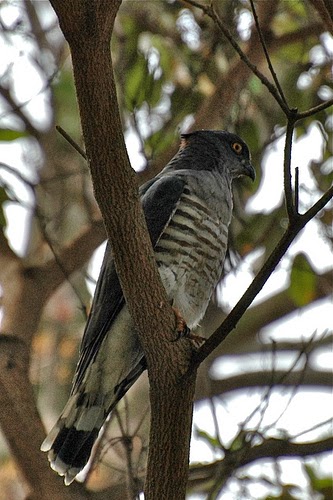
To Crash Others' Nests, Cuckoos Impersonate Birds of Prey


In the avian world, cuckoos are the villains you root for. These diabolical birds can trick others into raising the cuckoos' young instead of their own. From a thick playbook of deceptions, one trick cuckoos use is to impersonate local bullies. This apparently convinces their victims to let cuckoos walk right into their nests.

Cuckoos live all over the world, and most species are model citizens, building their own nests and raising their own offspring. But many species are so-called brood parasites, which sneak their eggs into other birds' nests. Some species match the egg's color to their host's eggs to disguise it, while others don't bother, depending how clever their preferred targets are. In certain species, male cuckoos goad the host parents into chasing them off while females creep into the nest and lay their eggs.

The parasitic cuckoo hatches earlier than the other eggs in its nest and gets a head start in begging the host parent for food. It may mimic the appearance of its nestmates. Often, it kicks them out of the nest altogether. The clueless host parent feeds and raises the young cuckoo until it can fly off on its own.

Obviously, it's in the best interest of host birds to keep cuckoos out of their nests in the first place. Parasitic cuckoos and their host species engage in a constant evolutionary arms race, with the parasite's tricks and the host's defenses always improving. Thanh-Lan Gluckman, a Ph.D. student at the University of Cambridge, and her advisor, Nicholas Mundy, studied one of these tricks: plumage that disguises cuckoos as birds of prey.

It's no secret that certain cuckoos resemble certain raptors, and vice versa. The hawk in the photo above (left) is named the African cuckoo-hawk because of the likeness. Gluckman and Mundy wanted to measure that likeness: How similar is the plumage of raptors and cuckoos? And is that similarity stronger in species that live in the same area, suggesting the cuckoos have evolved to mimic specific birds?

The researchers focused on the chest feathers, where many cuckoo species have a "barred" pattern that's similar to many raptors'. It makes sense that the cuckoo's front side would be disguised, rather than its back, because that's what a host bird sees as a cuckoo swoops toward its nest. (And the last thing it sees before its young are replaced with aliens.)

Using museum samples, the authors photographed the plumage of representative birds. Then they transformed the images digitally to represent how they'd look through a bird's eyes. Characteristics of the barred pattern—how big the markings are, how consistent or variable the pattern is, and so on—were compared between five Old World cuckoo species (each representing a different genus) and raptors that share their territory.

All five cuckoos had patterns that matched a local raptor, such as a hawk or buzzard that overlapped with their territory. But when the scientists compared pairs that didn't live in the same area, there was no match. This suggests that cuckoos don't just imitate raptors in general; instead, they've evolved to match specific birds that live around them.

If the raptor it's imitating is local, that means the cuckoo's intended victim—the bird whose nest it's about to invade—will recognize it too. Gluckman says the purpose might be frightening host birds so they don't attack, "or making them misjudge what the cuckoo is for long enough to access the nests." A cuckoo can toss its host's eggs from the nest and lay its own in just ten seconds, she says. Alternately, males that are imitating a dangerous raptor might convince host birds to chase after them, also buying the female time to sneak into the nest.

It will take more research to show exactly how host birds react to an approaching cuckoo disguised as a bird of prey. Probably how they should react is to just move underground, because nothing else seems to be working.


Images: Left, African cuckoo-hawk by Ken Clifton; right, Oriental cuckoo by Tom Tarrant (both via Flickr).

Thanh-Lan Gluckman, & Nicholas I. Mundy (2013). Cuckoos in raptors' clothing: barred plumage illuminates a fundamental principle of Batesian mimicry. Animal Behaviour DOI: 10.1016/j.anbehav.2013.09.020

Fish Evolve Stabbier Genitals When Predators Are Near


Like sock garters and homburg hats, the equipment used by our great-grandparents doesn't always cut it for later generations. Certain male fish have evolved differently shaped genitals depending on what other fish share their caves. Attracting females, though, doesn't seem to be as important as not getting eaten.

Most fish reproduce simply by scattering a lot of of eggs and sperm around their environment. But a few types of fish are "livebearers": their eggs are fertilized and hatched inside the female's body, then come swimming out as fully formed miniature fish. Many sharks bear live young. So does Gambusia hubbsi, the Bahamas mosquitofish.

The main difficulty of reproducing this way—at least, the main difficulty from a male perspective—is getting the sperm inside the female's body. You can't just leave it around the ocean and hope for the best. Males in the mosquitofish's family solve this problem with an organ called a gonopodium. The body part's overall size is subject to a couple of different evolutionary pressures: Females of some species prefer a larger gonopodium. But carrying around the bigger organ slows males down when they're trying to escape predators.

Justa Heinen-Kay and R. Brian Langerhans at North Carolina State University were curious about just one part of the gonopodium. The tip is tiny but weapon-like: about one millimeter long, it carries bony hooks, spines, and teeth. It's not big enough slow males down while swimming, or visible enough for females to judge it. Yet the authors wondered whether other evolutionary pressures might be acting on this spiky little body part.

The researchers collected mosquitofish from water-filled, vertical caves in the Bahamas called blue holes. Certain populations of mosquitofish live in caves that also contain their predator Gobiomorus dormitor, the bigmouth sleeper. Other populations live with few predators, and can swim and mate—a process that may or may not involve female cooperation—without the threat of being eaten.

Comparing mosquitofish from 10 caves with predatory bigmouth sleepers and 12 caves without them, Heinen-Kay and Langerhans saw that the fish had evolved different genital shapes. Male mosquitofish that lived with a lot of predators had longer tips on their gonopodia, and those tips were more densely covered in bony bits.

This sturdier, stabbier tip may help a male to work more quickly and efficiently, whether or not the female wants him to. The authors speculate that when predators are nearby and time is short, this genital shape is an advantage. Bony hooks "may serve as holdfast devices," and a longer shape might get sperm farther inside the female while pushing out anything competitors have left behind. But in caves without predators, they add delicately, "males may rely more on cooperation and less on genital shape."

However it helps, modifying the shape of their genitals must be a powerful tool for mosquitofish. Over and over again, fish populations living with predators have evolved in the same way. It's a trend that's here to stay—despite what their ancestors might think.


J. L. HEINEN-KAY, & R. B. LANGERHANS (2013). Predation-associated divergence of male genital morphology in a livebearing fish. Journal of Evolutionary Biology DOI: 10.1111/jeb.12229

Image: Heinen-Kay and Langerhans.

Unempathetic Kids Don't Get Sarcasm


A crucial tool in your social survival kit is the ability to tell when someone means the opposite of what they're saying. For centuries, writers have tried to aid readers' detection of sarcasm with various typographic contortions: backward question marks, upside-down or zigzagged exclamation marks, even left-leaning italics dubbed "ironics."* (None of these have stuck, probably because pointing out when you're being sarcastic totally ruins it.)

For kids, sarcasm is a developmental hurdle to clear. At some point while they're growing up, they learn that positively worded statements—"Wow, great job"—aren't always positive. When psychologists at the University of Calgary began their recent study of kids and sarcasm, they started with a group of 6- and 7-year-olds. They expected that the children would be just beginning to grasp the skill. But when these kids showed "near-zero accuracy" at detecting irony, the researchers had to try again.

Thirty-one 8- and 9-year-olds became the new study group. For the experiment, each kid watched a series of 12 short puppet shows. The shows involved two puppet characters and ended with one of them saying either "That was so good" or "That was so bad"—sometimes literally and sometimes sarcastically. For example, one puppet misses a soccer goal; the other says, "That was SO GOOD." (A separate panel of adults had vouched for the sarcastic tone of the recorded dialogue.)

Kids had to decide after each show whether the final line of dialogue was nice or mean. They indicated their answers by picking up either a small plush duck or shark. (The actual niceness or ironic tendency of these animals was not addressed in the study.)

When the puppets' statements were literal, kids had no difficulty interpreting them as nice or mean. But the sarcastic statements gave them more trouble. Their accuracy as a group was a little under 50 percent; the researchers explain that about half the kids seemed to get it consistently, while the other half were "quite inaccurate" at spotting sarcasm.

Subjects' parents also filled out questionnaires about how empathetic their children were—a good understanding of other people's emotions might go along with an understanding of when people are being shark-ish or duck-ish. Kids with higher empathy scores did better in the sarcasm test. Additionally, explains senior author Penny Pexman, video footage revealed that kids with better empathy were slower when reaching for the wrong toy than their less empathetic peers. In other words, when empathetic kids failed to find the sarcasm, they struggled more with their answers. They may have sensed that there was another layer to the puppet's words: was that missed soccer goal really "so good"?

"We need to offer children extra supports when we use sarcasm," Pexman says. A second- or third-grader might have only a dim understanding of your clever one-liner. A first-grader will likely miss it entirely.

Additionally, "Encouraging children to be more empathetic has great benefits for understanding sarcastic speech," Pexman says. "We know from other research that empathy helps with other aspects of social functioning too." I mean, I GUESS that's a good thing.


*I learned about ironic punctuation in Keith Houston's book Shady Characters. There are a lot of good tidbits in there, from ampersands to octothorpes. The chapter on irony is summarized at Brain Pickings.

Image: by Spamily (via Flickr)

Andrew Nicholson, Juanita M. Whalen, & Penny M. Pexman (2013). Children's processing of emotion in ironic language. Frontiers in Psychology DOI: 10.3389/fpsyg.2013.00691


Elusive Marine Mammal Uses Interspecies Buddy System


What ocean mammal is a rare bird but not a lone wolf? Meet the false killer whale. You're not likely to ever spot one in the wild, but if you do, it won't be alone. These animals prefer to travel with a crowd—not just of their own species, but also including their closest companion, the bottlenose dolphin.

False killer whales are so named because the look a little like killer whales, or orcas.* Yet unlike their showy namesake, false killer whales are rarely encountered by humans. In most places where we know they live, it's only because they've turned up stranded on the shores. We don't even know whether they migrate with the seasons.

We do know that the whales are social, and that they sometimes pal around with other species. Jochen Zaeschmar, a master's student at Massey University in New Zealand, has been rescuing and studying false killer whales and other species since 2000. This summer he published a paper reporting that false killer whales sometimes partner with bottlenose dolphins to hunt. On two occasions, researchers had come across large groups of the whales and dolphins apparently working together to round up fish. They blew bursts of bubbles to herd their prey into one helpless crowd, then feasted.

For Zaeschmar's latest study, he and other researchers gathered up records of false killer whale sightings along the northeast coast of New Zealand between 1995 and 2012. It was a total of just 47 encounters—on one whale-watch boat, false killer whale sightings happened on less than half of one percent of trips.

The observations of whales and dolphins hunting together had been no (ahem) fluke. When false killer whales were seen, bottlenose dolphins were by their side "virtually all the time," Zaeschmar says—in 43 out of the 47 sightings.

"Increasing the size of your group...increases the chances of finding food," Zaeschmar explains. The prey fish hunted by these mammals are plentiful, but spread out. Working together could help the hunters find their prey, he says, and "once they do find it there won't be any competition, because there is enough for everyone."

It's also possible, Zaeschmar notes, that one species is just taking advantage of the other's superior hunting skill. The dolphins and whales seem to be working in a true partnership. But "it's difficult to really prove it."

Either way, hunting was happening during less than half of the mixed-species encounters. Yet the animals—anywhere from dozens to hundreds of them at a time—behaved like a single group. There must be some other reason they seek each other's company. "Social factors might play a role," the authors write. Staying in large groups might also help the animals keep an eye out for their own predators, which include (real) killer whales.

The researchers were able to identify some individual animals using distinctive marks and scars on their bodies, such as bites from cookie-cutter sharks (named for the shape of the bite they take out of their victims). Spotting certain animals over and over, the scientists could build a rough map of the animals' social structure. They found that "long-term associations exist between the two species," Zaeschmar says, "with some of the same dolphins observed together with the same whales [over] at least 5 years and 650 kilometers."

"These associations appear to be stable," he says. The two species stick together, whether they're ruthlessly rounding up prey or surprising a boatful of very lucky humans.


*Technically, both the false killer whale and the real killer whale are types of dolphins. But just because marine biologists like to make their lives difficult doesn't mean we have to, so I refer to the false killer whale here as a "whale."

Images: (top) Mazdak Radjainia, (bottom) David Hall.

JOCHEN R. ZAESCHMAR, INGRID N. VISSER, DAGMAR FERTL, SARAH L. DWYER, ANNA M. MEISSNER, JOANNE HALLIDAY, JO BERGHAN, DAVID DONNELLY, & KAREN A. STOCKIN (2013). Occurrence of false killer whales (Pseudorca crassidens) and their association with common bottlenose dolphins (Tursiops truncatus) off northeastern New Zealand. Marine Mammal Science DOI: 10.1111/mms.12065

Jochen R. Zaeschmar, Sarah L. Dwyer, & Karen A. Stockin (2013). Rare observations of false killer whales (Pseudorca crassidens) cooperatively feeding with common bottlenose dolphins (Tursiops truncatus) in the Hauraki Gulf, New Zealand. Marine Mammal Science DOI: 10.1111/j.1748-7692.2012.00582.x

The Elderly Make Even Worse Decisions Than Teens


The wisdom of aging may not apply to economic decisions. In a study of choices make about money, the oldest people performed the worst—even beating out the usual bad-decision champions, adolescents.

Agnieszka Tymula, a decision scientist at the University of Sydney in Australia, studies economic decision making in humans (and sometimes monkeys). With colleagues at Yale and New York University, she gathered 135 total subjects in four different age groups: teens (12-17), young adults (21-25), "midlife" adults (30-50), and older adults (65-90). All the elderly subjects were screened for dementia to make sure they had healthily aging brains.

At the start of the experiment, researchers gave the subjects $125 in cash. It was theirs to lose—or to more than double, depending on the choices they made. Then subjects made a series of quick decisions. For example, would you rather take a guaranteed loss of $5, or play a "lottery" where you're equally likely to lose $8 or $0? What about a guaranteed gain of $5, versus a lottery an unknown chance of winning $20 that's somewhere between 25 and 75 percent?

In these kinds of experiments, it's normal for people to avoid risk when making money—to accept a guaranteed $5, say, even if a 50-percent shot at winning $12 is a better choice on average. With losses, people act the opposite way; we'd rather enter the lottery than take a guaranteed loss.

There are other decisions that are just plain wrong, though. For example, if given a choice between a guaranteed gain of $5 and a lottery with a chance of winning $5, everyone should take the sure money. But people didn't always do this in the experiment. The two middle age groups made these wrong choices around 5 percent of the time. Teens, 10 percent. And older adults, when given a choice with a clear right and wrong answer, chose incorrectly almost 25 percent of the time.

Over the course of the experiment's 320 decisions, the oldest adults were also the most likely to behave inconsistently, choosing the opposite of what they'd done earlier when facing the exact same choice. (Teens, again, were in second place.)

At the end of the experiment, the researchers gave subjects actual cash (or took it away) based on a subset of the choices they'd made. If every decision had been for real money, the oldest adults would have walked away with a walloping 39 percent less cash than young adults. Middle-aged adults did roughly as well as young adults, and teens did a bit worse—though not nearly as badly as the elderly.

Agnieszka Tymula says the choices in her experiment, which was sponsored by a grant from the National Institute on Aging, are simplified versions of real choices we make all the time. "Most important real life decisions are taken under conditions of uncertainty," she says. When we invest in the stock market or choose a health insurance plan, we have to weigh unknown risks and payoffs. And we may have a harder time making those decisions as we age. The authors write, "Elders borrow at higher interest rates, use credit balance transfers suboptimally, misestimate property value, and pay more fees to financial institutions."

In future studies, Tymula wants to try to pin down what biological changes lead an aging brain to worse choices. "Ideally, we would like to follow a very large sample of people throughout their whole lives," she says, "to precisely identify when changes in decision-making occur and identify risk factors." This might help researchers design treatments that will dial back the brain to a younger mode of decision-making—though not, of course, all the way back to the teenage years.


Image: by Artis Rams (via Flickr)

Agnieszka Tymula, Lior A. Rosenberg Belmaker, Lital Ruderman, Paul W. Glimcher, & Ifat Levy (2013). Like cognitive function, decision making across the life span shows profound age-related changes. PNAS DOI: 10.1073/pnas.1309909110

Mice Mark Their Territory with Song


Like warring street-corner troubadours, certain mice sing to claim their territory. They may not get any tips in their guitar cases, but by knowing where it's safe to sing, they keep the whole neighborhood harmonious.

Two related species of singing mice share the mountains of Costa Rica and Panama. One, Scotinomys teguina or Alston's singing mouse, lives at lower altitudes and is widespread in the forests of Central America. The other species, Scotinomys xerampelinus or the Chiriquí singing mouse, resides on the tops of the mountains. Males of both mice make chirping calls, unique to their species, that attract mates and advertise to competitors.

But the two tuneful rodents don't exactly meet up for karaoke duets. Bret Pasch, a biologist at the University of Texas at Austin, investigated three mountains where a clear boundary line divides the territory of Alston's mice below from Chiriquí mice above. Why, he asked, is this division so sharp?

Using traps baited with peanut butter and oats, Pasch and his colleagues first documented where the boundary between mouse species was. Then they set up face-offs between males of the two species. Placing pairs of trapped mice in enclosures together, they saw that S. xerampelinus, the higher-altitude mouse, was more aggressive and tended to attack the lower-altitude species. (The lower-altitude mouse is probably wise to retreat, since it's a smaller animal.)

Returning to spots on the mountainside where they knew each species lived, the researchers broadcast recordings of both kinds of mice singing, and listened for responses. Chiriquí singing mice, the more aggressive species, responded to calls of either kind. But Alston's singing mice were more likely to hush up when they heard a song from their rivals. When a male Alston's singing mouse was by itself in an enclosure, the sound of the other mouse's song—played from a speaker—was enough to make it retreat to a far wall and stay there.

Pasch concluded that the higher-altitude mice aren't intimidated by their neighbors, but are restricted to the mountaintops by temperature. The lower-altitude mice, wary of encounters with their larger and more aggressive upstairs neighbors, stay away whenever they hear that mouse's song. When Pasch removed all the Chiriquí mice from certain boundary-zone areas (by trapping them and then carrying them across a river), he saw that Alston's mice quickly moved into the vacant territory.

Alston's singing mice use their relatives' song as a hint to stay away, and Pasch says this sort of interaction could be widespread. "Closely related species often share similar ecological requirements—eating similar foods and living in similar places—as well as similar means of communication," he says. Because of this, communication between species "is probably common." Just don't expect them to appear together in concert.


Image: Alston's singing mouse, by Bret Pasch.

Bret Pasch, Benjamin M. Bolker, & Steven M. Phelps (2013). Interspecific Dominance Via Vocal Interactions Mediates Altitudinal Zonation in Neotropical Singing Mice. The American Naturalist DOI: 10.1086/673263